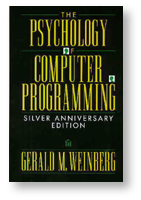
| "This is a book that stimulates the reader. . .
. There is a wealth of knowledge here for anyone involved in Process Improvement. "There
is much to gain from this book even if the reader is not a programmer, and even
if the reader does not know how to program, because its focus is software development
staff and the relationships that exist between them." —Alan
Richardson
Compendium Developments
"I recently reread parts of The Psychology of Computer
Programming that seemed very radical to me when I first read them in 1971.
As I look around at today's programmers, I can see what a large, beneficial effect
that work has had." —Richard Mateosian
IEEE Micro
"I listed this book as one of the best books
of the year in my annual column published in the September, 1999 issue of Journal
of Object-Oriented Programming and could probably do so again in another twenty
five years." —Charles Ashbacher
Charles
Ashbacher Technologies
posted on Amazon.com
"Whether
you're part of the generation of the 1960's and 1970's, or part of the current
generation of the 1980's and 1990's, you owe it to yourself to pick up a copy
of this wonderful book. Once you've digested it, you should then track down all
[twelve] of the other Weinberg textbooks published by Dorset House. . . . Every
one of them is a jewel." —Ed
Yourdon
Cutter IT E-Mail Advisor
"On
an inspired eight-week vacation in Italy, I wrote the first draft of The Psychology
of Computer Programming. ". . . the book quickly became a best-seller
among technical titles, running through more than twenty printings and staying
in print for twenty-five years. . . . "For this Silver Anniversary
Edition, I decided to take my own advice to reviewees and not try to hide
my errors, for they would be the source of the most learning for my readers. I
decided to leave the original text as it was—antiques and all—for your
illumination, and simply to add some 'wisdom of hindsight' remarks whenever the
spirit moved me. I hope you find the perspective brought by this time-capsule
contrast as useful to you as it has been to me." —GMW
"What surprised me as I read it again was how timely
Weinberg's questions remain." —Dwayne Phillips
Editor's Choice
"I discovered the book in 1977,
and decided I wanted to work as an egoless software engineer, not as a radio disk
jockey. . . . Sometimes, oldies are goodies. Old books can be even better when
they're revised to assess their prophecies and sage advice." —
Johanna Rothman
Reflections, Rothman Consulting Group
"The Psychology of Computer Programming . . . was the first major
book to address programming as an individual and team effort, and became a classic
in the field. . . . Despite, or perhaps even because of, the perspective of 1971,
this book remains a must-read for all software development managers." —J.J.
Hirschfelder
Computing Reviews
". . . many of the
lessons about managing and leading people are as timely as they were today as
they were when the book first appeared." —C.J.
Van Wyck
CHOICE
"In this new edition,
Jerry looks at where we were 30 years ago, where we are now and where we might
be in the future. Instead of changing the original text, he's added new comments
to each chapter. This allows the reader to compare and contrast his thinking over
the decades, showcasing the errors and omissions as well as the threads that bore
fruit. ". . . one issue -- communication -- has been at
the core of Jerry's work for decades. Unknown to him at the time, Psychology
was to form the outline of his life's work. . . . Psychology is valuable
as history in a field that is all too ready to repeat the errors of its past.
Read Psychology as a picture of where we've been, where we are now, and
where we need to go next. Read it as an index to the thinking of one of the most
influential figures in our field." —Sue Petersen
Visual Developer
". . . Weinberg's book isn't loaded up with one-liners, but rather provides
an almost Freudian dive into the personalities of the people you work alongside.
When I read it in the late 1970s (it came out in 1971) I was blown away by its
dead-on-ness." —Alexander Wolfe
InformationWeek.com |