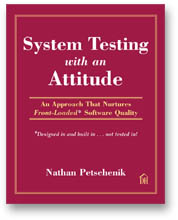
Quality
cannot be tested into software, it must be designed in and built in. Understanding
and accepting this simple principle can be the first step to preventing serious
system defects from reaching users.
Projects that routinely rely on the
system test team to uncover major implementation mistakes are bound to fail. The
system test phase occurs too late in the life cycle to make major improvements
to the overall quality of the product. Projects striving for high quality and
rapid time to market need to adopt an attitude that it is unacceptable for software
that does not meet requirements to even reach the system test phase.
Instituting
this attitude requires agreement on roles and responsibilities throughout the
entire project team. System Testing with an Attitude explains how to cultivate
productive relationships between developers and system testers and stresses the
importance of identifying and delineating the responsibilities of each group,
which can prevent problems in the system before system testing even begins.
However,
changing attitudes and allocating responsibilities is only part of the formula
for system testing success. The system test team needs a technical and procedural
framework to achieve excellence in performing its allocated responsibilities.
The book provides system testing solutions that will help you:
- set
the right priorities for system testing (which simultaneously clarifies the role
of developer testing)
- understand the users of your software
-
build well-documented, repeatable, data-dimensional system tests that cover typical
business flows
- reduce test-execution costs through the use of automated
test tools
- manage the end game of the software development process effectively
- institute a comprehensive measurement program that keeps progress visible
and accountability clear
Testers, managers, and developers who are
ready to improve their software development process should read this book.
Reviews
". . . this
book contains all the right stuff, and it is well written. There aren't exactly
standards for writing a book on system testing, but if there were, this book would
meet them.
". . . this is by far the best game in town on the subject of
system testing."
—R.L. Glass
ACM
Reviews.com
"Projects striving for high quality and rapid
time to market must adopt an attitude that makes it unacceptable for software
that does not meet requirements to even reach the system test phase. . . .
"Testers,
managers, and developers who are ready to improve their software development process
should read this book."
—Michael J. Lutz
IEEE Computer
"An exceptionally well-written book that explores
concepts of system testing and goes on to present a philosophy that can be readily
applied on any software project. . . .
"What sets this book apart is the
author's free use of examples, tables and diagrams that eases the understanding
of the material. A handy reference for experts and a classic for the rest."
—R.
Betala
posted on Amazon.com
". . . this has got to be one of the best books on System Testing that's
available for those of us in the game of Formal System Testing. . . .
"I
urge you to buy this book, read it, and use the information contained within.
You'll do a better job of System Testing if you do that."
—Rodger
Drabick
author of Best
Practices for the Formal
Software Testing Process
"Part
I covers system-testing issues, and Petschenik actually begins his book with a
test on system testing. (I like the strategy of starting a test book with a test.)
This self-assessment grounds the audience and gives us a good window into the
book. . . .
"What is refreshing is the acknowledgement
that proper and successful system testing requires everyone to understand the
various roles throughout the entire development
process. . . .
"Petschenik
demonstrates quality, not quantity, with good structure and balance . . .
"I
recommend this book to my project teams and will encourage them to conduct the
sort of role-awareness seminar Petschenik describes."
—Laura
Rose
The Rational Edge
"As a former
test manager, I would have found this book very useful in helping me to understand
both my role within the organization, and the issues inherent in that role. I
would also recommend it for development managers and project managers; the basic
premise (clearly defined roles, agreed to by all parties) makes too much sense
to be ignored."
—Joe Saur
ACM
Engineering Notes
". . . an informed and informative
understanding of the problems and issues often confronted in computer oriented
careers. Providing its readers with an invaluable approach to the proper application
of system testing and developer-led testing, understanding the software's user,
reduction of system-test costs, and increase of productivity by methodical technique
and tool utilization, management of the "end game" of software developmental effectiveness,
and institution of comprehensive measurement programming, System Testing With
An Attitude is a superbly presented, "user-friendly" collection of accessibly
helpful, usefully practical, readily applicable information. System Testing
With An Attitude is very highly recommended . . ."
—Midwest
Book Review
"System Testing
With an Attitude deals specifically with system testing and is a change from
other software testing books, which try to squeeze all levels of test into one
book.
". . . PetschenikÕs writing style is down-to-earth and quite
refreshing. There are no ten-dollar words, and he speaks from practical experience.
He uses a lot of personal examples and even gives the reader an opportunity to
walk through a few exercises to grasp the concepts discussed.
"Now
that I have read System Testing With an Attitude, I have the ammunition
I need to fight back. I now have the ability to present the argument, with teeth
I was lacking before. . . . I now have the ability to make it a win-win situation
for all concerned. I recommend that this book be on your shelf."
—Terry
Stewart
StickyMinds.com