Find Jerry's eBook nonfiction and novels listed at Amazon,
Apple, Barnes & Noble, and Smashwords stores, and at www.geraldmweinberg.com.
The
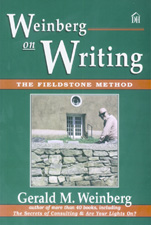
Writing Method That Works for One of Our Most Popular Authors
About the Book
Gerald M. Weinberg, author of more than forty
books -- including eighteen published
by Dorset House -- reveals his secrets for collecting and organizing his ideas
for writing projects.
Drawing an analogy to the stone-by-stone
method of building fieldstone walls, Weinberg shows writers how to construct fiction
and nonfiction manuscripts from key insights, stories, and quotes.
The
elements, or stones, are collected nonsequentially, over time, and eventually
find logical places in larger pieces. The method renders writer's block irrelevant
and has proved effective for scores of Weinberg's writing class students.
If
you've ever wanted to write a book or article -- or need to revitalize your writing
career -- don't miss this intimate glimpse into the mind behind some the computer
industry's best books.
Topics Include:
learning
to care about what you have to write
exercises in playing with your words
when
is it plagiarism
the structure of creation versus the structure of presentation
stimulate
your memory
getting published
and much more
Insights
from the Book
"What
would you really like to write? For many would-be writers, this is the hardest
exercise of all. They've never in their lives allowed themselves to think about
what they wanted. So, put aside everything your teachers told you, your parents
told you, your boss told you, your spouse told you, or I told you. Dream your
dream. Would you like to write about how to play pinball? What it feels like to
canoe a Class Five rapids? Your grandmother's knitting? What's wrong with the
design of some computer system? Peace in Ireland? What you'd like your children
to know about you? Something to amuse your grandchildren? How you get in touch
with God? I can't tell you. This is where you have to find out for yourself.
"Can
it be more than one thing? Certainly. Are you allowed to get it 'wrong'? Absolutely.
Can you change your mind later? Definitely. But right now, let your heart tell
you what you'd like to write. Then write it down -- just the title, or titles.
Any more than that is optional.
"Don't be disappointed
if you can't identify what you really want to write. Quite likely, you'll find
many answers, but none will be the final answer. I knew when I was eight years
old, but I didn't know I knew until about forty years later."
-- from Chapter 1
Reviews
"Don't
write your book -- build it with Weinberg's Fieldstone Method. Keep the project
moving by breaking the project into easy-to-attack chunks; gather your ideas one
at a time. Then stack them as you would stones in a wall."
-- Dan Poynter author of Writing Nonfiction and The Self-Publishing
Manual
"It wasn't until I participated in
one of Jerry Weinberg's writing workshops that I was able to take my writing to
the next level. . . .
"I'm proof these techniques work. I've published
three books, over 100 articles, and am working on my next few books. Next few
books, you ask? Yes. One of the techniques Jerry suggests is that you have many
fieldstones, chunks of work in progress. In progress may mean you've written two
words. It may mean you've written several chapter-like things. It may mean you've
written 50 words. Fieldstones allow you to make progress on any piece of work,
which can allow you to finish more writing projects than you could imagine.
"If
you want to start your writing career, or if you want to write better, or if you
want to revitalize your writing, buy this book. "
-- Johanna
Rothman author of Hiring the Best Knowledge Workers, Techies &
Nerds
"Part memoir, part how-to, Weinberg on Writing
dispenses with the mysteries and misconceptions of craft and shows any writer
how -- and how not to -- hone their skills. Weinberg's method of finding fieldstones
with which to build your writing strikes me as one of the more effective metaphors
for the writing craft I've ever seen. Weinberg also rightly places the emphasis
on writing about what matters to you rather than perpetrating the old saw, 'Write
what you know.' Writers of any stripe will go far following Weinberg's method."
-- Jennifer Lawler author of Dojo Wisdom for
Writers
"Jerry Weinberg's lessons in writing are smart, funny,
memorable, wise, engaging . . . and, most important, it is all stuff that works,
it's practical. What more would you want?"
-- Howard
S. Becker author of Writing for Social Scientists
"I
suppose the strongest praise of a how-to writing book would be to say it's changed
the way I intend to organize and write my next book. And it's true! I'm now beginning
to gather information and think about the structure of my next project, and I'm
going to adopt Jerry's Fieldstone Method. I think Jerry has made my writing life
easier. This book is a gift to writers at all levels from a true pro with sterling
credentials."
-- Penny Raife Durant award-winning
author of nine children's books, including When Heroes Die and Sniffles,
Sneezes, Hiccups and Coughs
"Weinberg on Writing is a strange
little gem: part writer's guide, part personal philosophy, and part autobiography.
As such, it has something to offer for writers of non-fiction and fiction alike
-- and would also be a good read for anyone who has ever wondered where writers
get their ideas."
-- Jane Lindskold author of The
Firekeeper Saga
"After 40 plus years of writing
books articles and web postings, I finally understand what's been going on. Jerry
Weinberg has encapsulated in this book why I love writing. I guess I've always
followed his first commandment: Never attempt to write something you don't care
about.
"Sometimes it's hard, but as he pointed out that's
usually because I'm trying to write the wrong thing. Sometimes I feel self-conscious
throwing myself into my writing, but I'm not going to do that any more.
"Thanks
Jerry!"
-- David C. Hay author of Data
Model Patterns
"Two friends and I argued over the pains of
writing while watching a magnificent sunset over the Pacific in Ocean Beach, San
Diego. . . .
'"I read this book by Gerald Weinberg,' I replied, 'in which
he described convincingly how efficient it is to gather fieldstones throughout
life (snippets of anything that carry energy for you) and later use them as needed
in your writing.'
'"Though I do notice fieldstones, I never remember
them later,' Patrick complained, even as I was capturing that interaction -- admittedly
the first time ever I had prepared for such event. . . .
"At that time,
I had no idea how I would use that dialogue until four days later I decided to
write a review on Weinberg's book. I decided to use that very fieldstone to capture
the reader's attention regarding fieldstones. Did it work? I find Weinberg's method
so convincing and practical . . . invest in this book, and I bet it will W.O.W.
you!"
"One
of the best lines of Weinberg on Writing, and one every writer should commit
to memory is, 'I may run out of ideas, but I'll never run out of new combinations
of ideas.' In demystifying the mysterious process of writing through the consistent
metaphoric grappling hook of 'fieldstones' as ideas which float in and out of
our consciousness, Weinberg has written a wise and warm book on overcoming the
perils of trying to write."
-- Gabriele Rico,
author of Writing the Natural Way
"Weinberg
on Writing is a combination of tales from Jerry Weinberg's long writing career
and hands-on exercises. I particularly resonated with the tale he tells in the
beginning, about how writing classes in school almost killed his desire to write.
School almost did that for me too. Jerry's method is different. Collect what gives
you energy, play with your collection, organize when you're ready.
"If
you have an interest in writing, want to try another style, or find your fun back
doing it, I find Weinberg on Writing worth checking out."
--
Willem van den Ende works as programmer/trainer/coach, writes a weblog.
Would like to write more.
"If you're thinking about
writing a book, Jerry Weinberg, author of more than 40 books and 400 articles,
has just published an entertaining reference for writers, Weinberg on Writing:
The Fieldstone Method. It's a great resource for new and veteran authors."
"In his new book,
acclaimed consultant, teacher, and author Jerry Weinberg introduces his approach
to writing called The Fieldstone Method. This is not a book about grammar or style,
but about *getting things written* -- and cutting yourself some slack in the process.
In today's world of blogging and "agile publishing," Weinberg's evolutionary,
non-linear method is especially welcome. This excerpt explains how Fieldstoning
can break the cycle of writer's block."
"A frequent pastime for all writers and aspiring writers
is to read books of advice on how to write. . . . Weinberg has produced 30-plus
books and 100s of articles over his career. He has also combined a career that
started out dealing with technology and transformed to dealing with organizations
and the behavior of the people in them. That mixture leads to a view about the
practice of writing that is among the most actionable and most aligned with the
world I find myself in than anything I have yet encountered. Weinberg is not concerned
with the mechanics of writing or particularly with the low-level details. Instead,
his focus is on how to integrate the process of writing into the rest of your
daily world in a way that makes each better.
-- Jim McGee
consultant and author of the weblog McGee's
Musings
". . . this is a fun, interesting book
which takes a perspective which is unusual and stimulating. . . . 'The Feldstone
Method starts with gathering, not with organizing.' This is, in a nutshell, what
makes the concepts in this book different from most other books on writing."
-- Maggie Ball The Compulsive Reader
"Building
a fieldstone structure requires gathering the right stones in a step-by-step process,
as fieldstones vary in size, color, texture, shape and density. Similarly, writing
a book requires the gathering of ideas or as Weinberg succinctly reminds us, "snatches
of writing, photos, diagrams, quotations, pictures, and references that you find
interesting. . . ."
"Weinberg has written a clever
writing manual. On one level it is highly readable and on another it is packed
with excellent insights into how to effectively perfect the writing process with
less pain and much more enjoyment."
". . . an informed and informative instructional reference
to the process and skill of effective writing. Weinberg introduces the reader
to forty-four exercises and offers many insightful tactics. Weinberg On Writing
is an excellent detailing of all the necessary steps to be taken amidst the attempts
and struggles of writing a book. Weinberg enlightens the readers to many original
and particular strategies rarely recognized or pursued. . . . very strongly recommended
to all aspiring authors particularly oriented or favoring the presence of nature
in their writing."
-- Diane Donovan Editor,
Bookwatch
"Weinberg on Writing describes
the actual process a real person goes about when coming up with ideas for a piece,
how he organizes those ideas, and little things like transitions and word choice.
It will be especially helpful with people trying to get published in a magazine
for the first time or people who produce technical documentation for a living.
".
. . I've never read a book so specific, down-to-earth, and approachable about
the writing process. Most of what I have learned about writing was learned by
finding *bad* writing, learning the symptoms, and trying to avoid them. This book
actually provides positive, specific steps to improve the quality of your writing,
along with exercises. . . .
"As for the actual process
of writing, this book is far and away better than anything else I have ever read.
Five Stars. Buy it today."
-- Matt Heusser Software
Developer
"As a writer, I was very excited about
the prospect of learning from Weinberg himself his thoughts on the writing process.
I was not disappointed. This book set me free as a writer. The fieldstone approach
gave me the freedom to use many of the articles, quips, replies to e-mail questions,
and other smaller writings as a basis for books. The basis of the approach is
that instead of working from an outline or trying to write something from beginning
to end, you approach the project like someone building a structure from natural
stones. . . .
"I firmly believe that one of the best and
fastest roads to success for anyone is to write well. The better you write, the
more exposure and credibility you get. I recommend this book to anyone who writes,
who may aspire to write and also to those that are intimidated by the thought
of writing."
"It's the closest thing to being in a Weinberg workshop .
. .
"I wonder how different my writing life would have
been if my freshman English teacher in college had had access to Jerry's book
as a text. I can't answer that question, but I can say that my writing life has
been changed by Jerry in person and by Weinberg on Writing, for the better
in each case!"
"This is THE book on writing. Short and sweet: in a thin
paperback, Weinberg covers the entire spectrum from mechanics of organizing paragraphs
to how to gather and integrate your ideas. Weinberg comes from the software field,
but knows how to write a book I couldn't put down. It has automatically become
one of my "toolkit" books -- one of a few I'll keep on my shelf to refer to regularly.
"You don't just work on one thing. You work on many different
things and there are many different kinds of activities you can do when you 'slow
down.'"
"I've taken much of his book to heart . . . Let this
book work its magic on you. The changes seem obvious and subtle. However, they've
seemed to work well for me."
". . . a thought-provoking book about how to write using
the metaphor of building a fieldstone wall. Jerry Weinberg addresses the problem
of writer's block by showing how metaphorical stones can be continually collected.
. . . The process of collecting stones typically contributes to ongoing work on
a number of potential finished books, articles, reports or even blog entries.
. . . Of the many lessons in this book worth heeding my favourite is Jerry's first:
"Never attempt to write something you don't care about". After all, a fine stone
wall is built by a master craftsman with passion. Writing should be similar."
"Is your brain feeling rusty? If being
creative feels impossible at the moment, try something more or less 'mechanical,'
suggests Gerald M. Weinberg. . . Once you're in, you have a chance to reach
the creative zone. . . .
"When you have to write something
for work or school, that is, when you're not writing exactly what you most want
to be writing, Weinberg suggests that you ask yourself to describe 'an approach
to converting the assignment into one you do care about.' Flow theory agrees:
any activity can be turned into a flow activity if you raise the challenge just
enough to engage your interest. . . ."
". . . Has very straightforward
and approachable advice for getting past writer's block, gathering and finding
the bright shiny things that you can assemble into your new work, and bringing
a workmanlike attitude to the artistic process. I think it has applications for
the visual arts, as well."
"Studded with lots of examples and exercises for the
reader, the book could help writers of all genres and all skill levels; the most
important lesson is not to just fight through 'writers block' but to leap around
it and Weinberg seems to have found a metaphor, the 'Fieldstone Method,' that
will work if faithfully practiced. But then the proof of this statement will have
to, for me, wait for its actual use in practice!
"I must admit
that the reading was so good I skipped those exercises best done in teams. That
said, the self discovery that came from the solitary exercises I did complete
was great enough that I will be going back through the book, at a more leisurely
pace, to ensure that I make use of the remaining ones -- something I have never,
in any book of this nature, had any interest in doing. That in itself is testimony
to the power of the book."
To order this book by credit
card directly from Dorset House in New York, please call (800) 342-6657
or (212) 620-4053, weekdays, 9am to 6pm. Alternatively, print out our Faxable
Order Form and fax to (212) 727-1044.
To order
this book from an online bookstore, please see above.
To
purchase at a bookstore, contact our Recommended
Booksellers to verify availability.
Any store can order from Dorset House using the book's title and ISBN number.
Also, bookstores can order our books through Baker & Taylor.
We'd
like to make it easy for you to order, so please contact
us at any time for help!
DORSET HOUSE PUBLISHING CO., INC. New:3143
Broadway, Suite 2B New York, New York 10027 USA 1-800-DH-BOOKSor 212-620-4053, fax 212-727-1044