This Title Is
Now Also Available As an eBook Through Pearson Education at www.informit.com. To
Order, Click
Here
About the Book
Build
Better Systems Using This Update to the Highly Acclaimed Hatley/Pirbhai
Methods
Derek Hatley and Imtiaz Pirbhai—authors
of Strategies for Real-Time System Specification—join
with influential consultant Peter Hruschka to present a much anticipated update
to their widely implemented Hatley/Pirbhai methods.
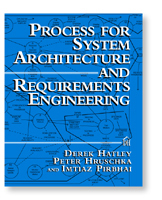
Process
for System Architecture and Requirements Engineering introduces a new approach
that is particularly useful for multidisciplinary system development: It applies
equally well to all technologies and thereby provides a common language for developers
in widely differing disciplines.
The Hatley-Pirbhai-Hruschka approach (H/H/P)
has another important feature: the coexistence of the requirements and architecture
methods and of the corresponding models they produce. These two models are kept
separate, but the approach fully records their ongoing and changing interrelationships.
This feature is missing from virtually all other system and software development
methods and from CASE tools that only automate the requirements model.
System
managers, system architects, system engineers, and managers and engineers in all
of the diverse engineering technologies will benefit from this comprehensive,
pragmatic text. In addition to its models of requirements and architecture and
of the development process itself, the book uses in-depth case studies of a hospital
monitoring system and of a multidisciplinary groundwater analysis system to illustrate
the principles.
Author Comments
Compatibility Between
the H/H/P Methods and the UML
The Hatley/Pirbhai architecture and requirements
methods—described in Strategies for Real-Time System
Specification—have been widely used for almost two decades in system
and software development. Now known as the Hatley/Hruschka/Pirbhai (H/H/P) methods,
they have always been compatible with object-oriented software techniques, such
as the UML, by defining architectural elements as classes, objects, messages,
inheritance relationships, and so on. In Process for System Architecture and
Requirements Engineering, that compatibility is made more specific through
the addition of message diagrams, inheritance diagrams, and new notations that
go with them. In addition, state charts, while never excluded, are now specifically
included as a representation of sequential machines.
These additions make
definition of the system/software boundary even more straightforward, while retaining
the clear separation of requirements and design at the system levels that is a
hallmark of the H/H/P methods—not shared by most OO techniques. Once the
transition to software is made, the developer is free to continue using the H/H/P
methods, or to use the UML or any other software-specific technique.
Excerpt
"The
overall purpose of this book is to present a broad approach to the effective development
of systems, especially those involving multiple disciplines—as most systems
do. We use a variety of practical, real-world case studies to illustrate the nature
of systems and the system development process, and we include system models that
can be used in the process.
"The book builds on the methods and
techniques originally described in Strategies for Real-Time
System Specification. It is based on more than a decade of experience, our
own and many others', in the practical application and teaching of the methods
and techniques. . . .
"The wide acceptance of the methods—which
have become known as the Hatley/Pirbhai methods—has been gratifying, but
not all practitioners have used them correctly or effectively. . . . Our goal,
then, is to share the benefit of our experiences, good and bad, in the hope of
improving the overall state of system development and the methods and tools that
support it."
"If one believes that all design is the process
of disambiguation, or the process of removing ambiguity from the form of the problem's
solution, then this book is a step in the right direction. Even though the book
is extremely complex, it is a seminal work, quite possibly destined to become
the bridge between two different types of pedagogical environments in the area
of requirements engineering."
—William M. Lipsmeyer International Journal of General Systems
"Process for
System Architecture and Requirements Engineering introduces a new approach
that is particularly useful for multidisciplinary system development. It incorporates
the coexistence of the requirements and architecture methods and of the corresponding
models they produce. These two models are kept separate, but the approach fully
records their ongoing and changing interrelationships."
"I think it is an excellent book. I would very
much like to use it as a textbook in my software/systems engineering class. .
. . By the time I was done, I had found most everything I was hoping was in the
book. . . I think the formalization of model elements using ERD or OO notations
is a great idea. . . . Right on! . . . . I applaud the use of StateCharts with
your syntax. I think it makes things much more understandable and eases modeling."
—Mark
Maier Aerospace Corporation
"I thought the
book was excellent. The authors did a great job defining the whole system development
process and demonstrated their understanding of how, and why, systems get designed;
or at least should be designed. The book contains a lot of history and experience
that has been gained by the authors throughout their careers. This book does a
good job of filling in the gaps from the first book. I especially liked the comments
related to object-orientation. I was happy to see all of the new things that are
now contained in the PSARE methods. I feel it is a must read for all systems engineers
and have personally recommended it to all my colleagues."
—Gary
Rushton Systems Engineering Technical Specialist AutoNeural Systems
"I recommend PSARE as the single most important reference for an
organization engaged in system architecture and requirements engineering. . .
. provides an excellent initial analysis of the requirements for a system development
process which likely has application in any industry.
"The authors'
approach to recognizing the synergy between the requirements and architecture
methods and that neither is more important, is profound. Recognition of this seemingly
simple fact may be instrumental in moving an organization forward in developing
system solutions and associated specifications.
"Part II of the book
(chapters 8+) includes useful case studies with numerous examples of the PSARE
application. These examples provide guidance for "what to do" and "how
to do it" and are invaluable for the novice and veteran system engineer."
—Arthur
Gajewski Vehicle Systems Engineering Supervisor Visteon Corporation
". . . presents an approach to the development of
systems that incorporates the requirements and architecture methods, and uses
case studies to illustrate the nature of systems and the system development process.
The case studies are a hospital monitoring system and a groundwater analysis system."
To
order this book by credit card directly from Dorset House in New York,
please call (800) 342-6657 or (212) 620-4053, weekdays, 9am to 6pm. Alternatively,
print out our Faxable Order Form
and fax to (212) 727-1044.
To order this book from
an online bookstore, please see above.
To
purchase at a bookstore, contact our Recommended
Booksellers to verify availability.
Any store can order from Dorset House using the book's title and ISBN number.
Also, bookstores can order our books through Baker & Taylor.
We'd
like to make it easy for you to order, so please contact
us at any time for help!
DORSET HOUSE PUBLISHING CO., INC. New:3143
Broadway, Suite 2B New York, New York 10027 USA 1-800-DH-BOOKSor 212-620-4053, fax 212-727-1044