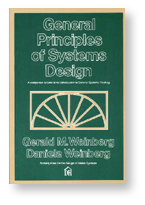
| Chapter 1 The Problem of Persistence Weinberg's
Law (s) of Twins
The Continuity Taboo
The General Systems Approach to
Continuity
Questions for Further Research Chapter 2 Aggregates The
First law of Aggregates
Births and Deaths—The Fundamental Aggregate
Equation
Differential Equations and Chronological Graphs
Questions for
Further Research Chapter 3 Birth-Free Aggregates Social Versus
Innate Survival
Exponential Decay
Alternative Ways of Representing Decay
Unimodal Life Tables, and Ogives
Composite Curves
Questions for Further
Research Chapter 4 Reasoning About Aggregates Cooperation and
Competition—The Law of Collapse
The Law of Typology
From Death to
Births
Reasoning in the Presence of Births
The Second Aggregate Law
Questions for Further Research Chapter 5 Modeling Differentiated Aggregates The
State Vector
Constructing a System of Equations
To Solve or Not To Solve?
Renaming Systems
The Renaming-Conservation Law
Simulation and Conservation
Tracers
Questions for Further Research Chapter 6 Programs for Models
of Differentiated Aggregates Varieties of Programs
Transitive Closure
- The Diagram of Possible Effects
Structure Matrices
Time Scale and Continuity
Projecting Possible Effects with a Structure Matrix
Partitioning a System
Questions for Further Research Chapter 7 Structure and Behavior The
Structure of Structure
Projecting Behavior With a Linear Program
Qualitative
Reasoning About Structure
Detecting the Presence of Structure
Questions
for Further Research Chapter 8 The Structure-Regulation Law The
Equivalence of Structure and Input
Can A Linear System Be Stable?
Why
Linear Systems Are So Popular
The Structure-Regulation Law
Questions for
Further Research Chapter 9 The Search for Regulation The Problem
of Multidimensional Regulation
Separation of Variables
The First Law of
Regulatory Compromise
The Second Law of Regulatory Compromise
Questions
for Further Research Chapter 10 The Homeostatic Heuristics The
Internal Environment
Identifying and Essential Variables
The Homeostatic
Principles
Questions for Further Research Chapter 11 Other Regulatory
Heuristics The Feedback Principle
Analyzing Feedback Loops
The
Piddling Principle
The Parallel Principle
Questions for Further Research Chapter
12 Types of Regulatory Mechanisms Conditional and Unconditional Mechanisms
Error-Control
Limitations of Error - Control
Anticipation
Questions
for Further Research Chapter 13 Regulation and Environment Acting
on the Environment
The Environment Regulation Laws
The Regulatory Model
The Game of Regulation
Questions for Further Research Chapter 14
When the Model Fails The Fundamental Regulator Paradox
Noise
Noise in Communication Systems
Noise in Models
Fudging the Model
Discarding
the Worn-out Model
The Road Ahead
Questions for Further Research Chapter
15 Making Regulation Mysterious The Impression of Intelligence
The Myth of Superiority
Searching for Nonexistent Set Points
Other Set
Point Fallacies
The Quest for Perfection
Questions for Further Research Chapter
16 Overly Simple Views of Regulation Plait Fallacies
The One-to-One
Fallacies
The Kool-Aid Fallacy and the Aspirin Illusion
The False-Alarm
Fallacy
Flareback
Taking Complexity by the Horns
Questions for Further
Research
Chapter 17 Blindness and Reversed Vision Hidden
Reserves
The Environment as Reference Point
The Homunculus Fallacies
Denying the Existence of Regulation
Questions for Further Research Chapter
18 Epilogue Questions for Further Research
Suggestions for Further
Reading Bibliography
Author Index
Subject Index
Return to Book Page
|